
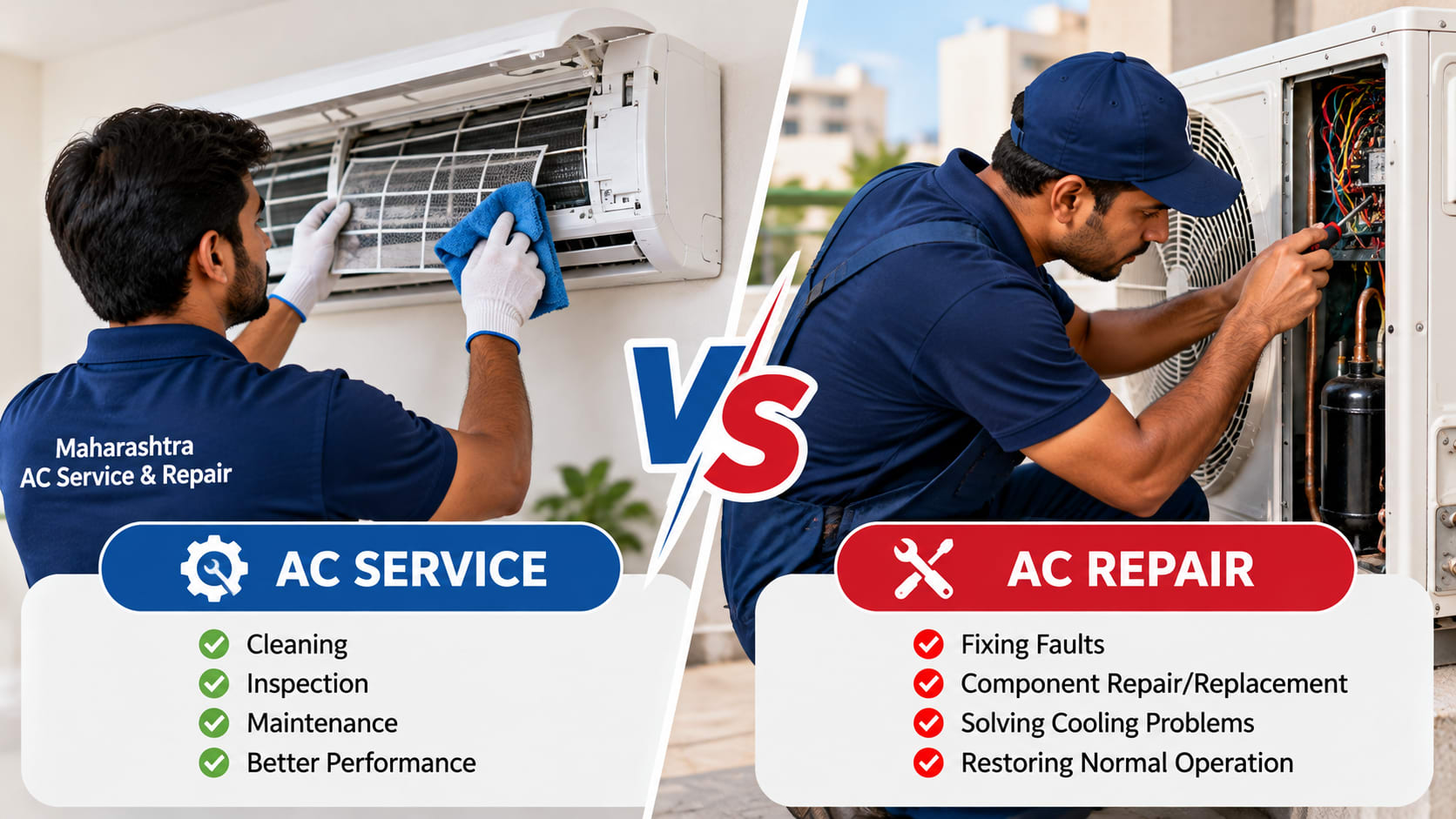
When your air conditioner stops cooling properly, makes unusual noises, or starts leaking water, you may wonder whether it needs a repair or a routine service. Both options help keep an AC working properly, but they solve different problems.
Understanding AC repair vs AC service can help you choose the right solution, avoid unnecessary work, and understand what a technician recommends. For example, a dirty air filter may need cleaning, while a faulty compressor or damaged drain pipe may require repair.
In this guide, Maharashtra AC Service & Repair explains the difference between AC servicing and repair, what each includes, when you need them, and how to make a sensible decision for your home.
Quick Answer: What Is the Difference Between AC Repair and AC Service?
AC service is preventive maintenance that helps keep an air conditioner clean and operating efficiently. AC repair is corrective work performed when a component or system develops a fault. Service may include filter cleaning, coil inspection, and drainage checks, while repair may involve fixing a leak, replacing a faulty component, or resolving a cooling problem.
What Is AC Service?
AC service is routine maintenance carried out to keep an air conditioner in good working condition. It focuses on cleanliness, airflow, drainage, and identifying possible problems before they become more serious.
During servicing, a technician checks the condition of relevant parts and performs maintenance appropriate to the AC type and its condition.
What Does AC Servicing Usually Include?
Depending on the unit and the service required, routine maintenance may include:
- Air filter cleaning: Removing dust that restricts airflow.
- Indoor unit inspection: Checking the visible condition of the unit and its airflow.
- Coil cleaning: Cleaning the evaporator or condenser coil when necessary.
- Drainage inspection: Checking whether condensation can flow out properly.
- Outdoor unit inspection: Looking for dirt, obstructions, or visible signs of damage.
- Basic performance checks: Checking whether the AC operates and cools as expected.
- General fault inspection: Identifying signs that may require further diagnosis.
Not every service visit includes every task. The work depends on the AC model, the condition of its components, and the service package agreed upon.
Why Is Regular AC Service Important?
Dust buildup, blocked drainage, and restricted airflow can affect cooling performance. Routine maintenance helps identify these issues and may reduce the chance of avoidable breakdowns.
Servicing is particularly useful if your AC operates for long hours, is exposed to dusty surroundings, or has not been inspected for an extended period.
However, servicing cannot prevent every fault. Electrical failures, refrigerant leaks, and worn components may still require separate repairs.
What Is AC Repair?
AC repair is the work required to identify and fix a fault that stops an air conditioner from working correctly. Unlike routine servicing, repair focuses on a specific problem and its underlying cause.
For example, if your AC runs but blows warm air, a technician may need to diagnose a refrigeration, electrical, airflow, or control-system problem before deciding what to repair.
Common AC Problems That Require Repair
An air conditioner may need repair when you notice any of the following:
- AC not cooling: The unit runs but does not provide sufficient cooling.
- Water leakage: Water drips indoors because of a blocked drain, damaged pan, or another fault.
- Unusual sounds: Grinding, repeated clicking, or abnormal humming may indicate a mechanical or electrical issue.
- AC not starting: The unit may have a power supply, control, or component problem.
- Repeated shutdowns: The system may be responding to a fault or overheating.
- Refrigerant leakage: A technician may need to locate and repair a leak before recharging the system.
- Fan or compressor problems: A damaged component may require testing and repair or replacement.
These symptoms do not always point to one particular fault. Proper diagnosis helps avoid replacing parts unnecessarily.
What Happens During an AC Repair?
A repair visit generally involves three stages:
- Diagnosis: The technician checks the reported symptoms and tests relevant components.
- Repair recommendation: The technician explains the suspected fault, proposed work, and expected charges.
- Repair and testing: After receiving approval, the technician completes the agreed work and checks the unit’s operation.
The exact process depends on the problem. Some faults need a straightforward adjustment, while others require replacement parts or more extensive work.
AC Repair vs AC Service: Key Differences
The main difference is the purpose of the work. Servicing maintains the AC, while repair addresses a fault that has already developed.
| Factor | AC Service | AC Repair |
|---|---|---|
| Main purpose | Preventive maintenance | Fixing a specific fault |
| When needed | At appropriate maintenance intervals | When a problem occurs |
| Typical work | Filter cleaning, inspection, drainage checks | Fault diagnosis, component repair or replacement |
| Main focus | Cleanliness and normal operation | Restoring faulty operation |
| Parts replacement | Not normally the main purpose | May be necessary |
| Result | Helps maintain performance | Addresses the identified problem |
| Cost | Depends on service scope | Depends on the fault, labour, and parts |
Actual work and charges vary by AC model, condition, location, and provider. A routine service does not automatically include repairs or replacement components.
When Should You Choose AC Service Instead of Repair?
Choose routine servicing when your AC is working reasonably well but needs cleaning, inspection, or scheduled maintenance.
For example, if the cooling is normal but the accessible filter is dusty, a service may be appropriate. Similarly, if you want the drainage system and coils checked after a period of heavy use, maintenance may help identify developing issues.
Consider booking AC service when:
- The unit has not received maintenance for a long time.
- Dust has accumulated on the filter.
- Airflow seems weaker than usual.
- You want the drain system and coils inspected.
- You want a technician to check the unit before a period of frequent use.
If the AC has developed a clear fault, do not assume that routine cleaning alone will solve it. Explain the symptoms when booking so the technician can plan an appropriate inspection.
When Do You Need AC Repair Instead?
Choose a repair assessment when the AC is malfunctioning, has stopped working, or shows signs of a component fault.
Examples include an AC that repeatedly shuts down, blows warm air despite correct settings, leaks water indoors, or makes unusual mechanical noises.
Before requesting repair, you can safely check the remote settings, inspect the accessible filter, and make sure the air outlets are not blocked. Do not open electrical panels, handle wiring, or attempt to repair refrigerant lines.
If you notice smoke, sparks, a burning smell, or repeated electrical tripping, stop using the AC and seek appropriate professional help.
Important: An AC may need both servicing and repair. For instance, a technician may need to repair a damaged drain connection and then clean the drainage system. Ask which tasks are included in the quoted price.
Can AC Service Fix an AC That Is Not Cooling?
Sometimes, but not always. If poor cooling is caused by a dirty filter or restricted airflow, maintenance may improve performance. If the cause is a refrigerant leak, faulty compressor, or electrical problem, the unit may need repair.
Use these steps to decide what to do:
- Check that the remote is set to Cool mode.
- Inspect and clean the accessible filter according to the manufacturer’s instructions.
- Check whether furniture or other objects block the air outlet.
- Observe whether the AC still blows warm air or shuts down unexpectedly.
- If the problem continues, arrange a professional diagnosis.
Do not request refrigerant refilling without checking the cause of low refrigerant. Refrigerant should not normally need annual refilling; a low level may indicate a leak that needs attention.
What Affects the Cost of AC Service and Repair?
The cost depends on the work required, so it is not possible to give one accurate price for every AC problem without knowing the details.
For routine servicing, the price may depend on the AC type, cleaning required, accessibility, and the tasks included in the service package.
Repair charges may depend on:
- The type and complexity of the fault.
- The time needed to diagnose and fix the problem.
- Whether replacement parts are required.
- The cost of the required components.
- The accessibility of the indoor or outdoor unit.
Before approving work, ask for a breakdown of inspection charges, labour, parts, and any additional service costs. Confirm whether the quoted amount covers testing after the repair.
AC Service and Repair in Pune and Mumbai
For households in Pune and Mumbai, AC maintenance is useful when the unit is exposed to dust or operates for long periods. A clean filter and unobstructed outdoor unit can help maintain airflow, while early attention to unusual noises, water leakage, or reduced cooling can help identify faults.
Maharashtra AC Service & Repair offers AC service and repair support within its stated service areas. Confirm availability for your locality and explain the problem before booking so the appropriate work can be discussed.
Conclusion
AC service and AC repair have different purposes, but both contribute to the reliable operation of your air conditioner. Service focuses on maintenance, cleaning, and inspection. Repair focuses on diagnosing and fixing a fault.
If your AC is functioning normally, follow the manufacturer’s maintenance recommendations. If it has stopped cooling, leaks water, or repeatedly shuts down, request a repair assessment rather than relying on routine servicing alone.
Contact Maharashtra AC Service & Repair to enquire about suitable AC servicing or repair options in Pune or Mumbai.
Frequently Asked Questions
1. Is AC service the same as AC repair?
No, AC service focuses on maintenance and cleaning, while AC repair fixes faults. A unit may need either one or both, depending on its condition.
2. How often should I get my AC serviced?
Follow the manufacturer’s maintenance schedule and consider usage, dust levels, and operating conditions. Clean accessible filters as recommended and arrange professional maintenance when required.
3. Can regular AC servicing prevent breakdowns?
Regular servicing can help identify dirt buildup, drainage issues, and early signs of faults, but it cannot prevent every breakdown. Electrical and mechanical components can still fail.
4. Should I get AC service or repair if my AC is not cooling?
Start with safe checks such as the remote settings and accessible air filter. If cooling remains poor, arrange an inspection because the cause may require repair rather than routine servicing.
5. Does AC repair always require replacing parts?
No, some faults can be resolved through cleaning, adjustments, or repairs to existing components. Replacement is necessary only when diagnosis shows that a component cannot be repaired appropriately or replacement is the recommended solution.